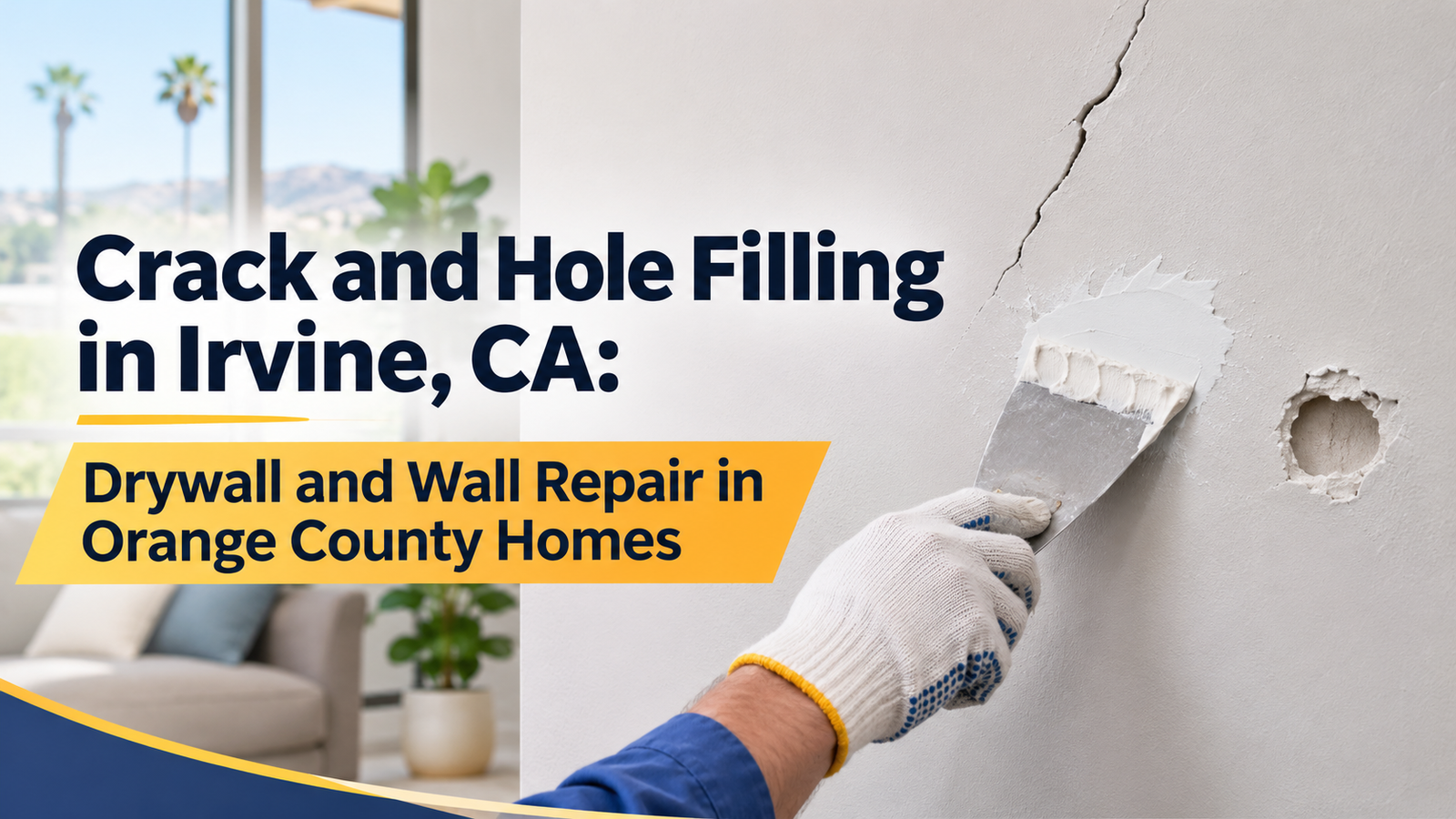
Cracks and holes in drywall are among the most common issues in Irvine’s residential homes, and they appear in everything from newly built tract homes in master-planned communities to resale properties from the city’s earlier development phases in the 1970s and 1980s. The causes range from the minor a nail hole from a hanging picture to the more significant, such as a stress crack and hole filling irvine from settlement or the larger opening left by a doorknob punching through drywall. Understanding what causes wall damage in Irvine homes, the methods used to repair different types of damage, and what affects repair quality and longevity is useful context for any Irvine homeowner dealing with wall and ceiling defects.
Why Drywall Cracks in Irvine Homes
Irvine’s climate and geology create specific conditions that contribute to drywall cracking in ways that differ from many other California regions. The city sits on the Irvine basin, underlain in many areas by expansive clay soils from the marine sedimentary geology of the Puente Hills and Santa Ana Mountain foothills. Expansive clays shrink when dry and swell when wet a behavior that creates cyclical foundation movement as the soil moisture changes with Irvine’s dry summer and wet winter seasons. This soil-driven foundation movement is a primary cause of hairline stress cracks in drywall, particularly at the corners of doors and windows where the drywall has less support and stress concentrates.
Thermal movement also contributes to drywall cracking in Irvine. Southern California’s climate involves significant daily temperature variation cool marine layer mornings can be followed by afternoon temperatures 20 to 30 degrees warmer in the inland Irvine neighborhoods. The wood framing behind drywall expands and contracts with these temperature changes. As wood framing dries and seasons after initial construction, it shrinks, pulling drywall fasteners slightly and sometimes creating the characteristic nail pops and hairline cracks that appear in the first year or two after a new home is built.
Structural settlement in Irvine’s expansive clay soil areas can produce more significant cracking cracks wider than a hairline, cracks that appear at both corners of a door or window in a pattern indicating differential settlement, or stair-step cracks in older drywall that indicate ongoing movement rather than a one-time event. These settlement-related cracks often require more than cosmetic patching; addressing the underlying foundation or drainage issue is important before repairing the drywall, because repairing over an active settlement issue will result in the crack reopening.
Types of Wall Damage and Appropriate Repair Methods
Nail holes and small screw holes (up to approximately 1/4 inch diameter) are the simplest drywall damage to repair. A lightweight spackle compound applied with a putty knife, allowed to dry, lightly sanded, and primed before painting is typically all that is needed. The repair is essentially invisible after painting if the texture is matched and the primer is applied before the topcoat.
Medium holes (from 1/4 inch to approximately 4 inches in diameter) the kind left by doorknobs, anchors, or small accidental impacts require slightly more involved repair. The standard method uses a drywall patch kit with a self-adhesive mesh or metal backing plate that bridges the hole and provides a surface for the joint compound. Joint compound is applied over the patch in two to three coats with sanding between coats to build a smooth, feathered surface that blends with the surrounding wall. As with all drywall repair, priming before painting is essential joint compound is highly absorbent and will show bleed-through if painted without primer.
Larger holes (over 4 to 6 inches) typically require a California patch or a full panel cut-out and replacement section. The California patch method cuts a square or rectangular section of drywall out around the hole, cuts a new patch piece to fit, and uses backing boards attached to the inside of the wall through the cutout to support the patch edges. This method does not require opening the wall to stud bays and is preferred when the stud bays contain insulation or wiring that would complicate full replacement. Full stud-to-stud replacement sections are used when the damage is extensive or when access to the interior of the wall is needed for other work.
Stress Cracks in Irvine Homes: Repair vs. Monitoring
Hairline stress cracks at door and window corners are one of the most common cosmetic complaints in Irvine homes, particularly in the city’s large inventory of one- and two-story tract homes where the common framing and foundation designs create predictable stress patterns. The key diagnostic question for any stress crack in an Irvine home is whether the crack is static (it formed once and has not changed) or active (it is continuing to grow or widen). Static cracks can be repaired with joint compound, primed, and painted with confidence that the repair will hold. Active cracks will reopen after repair, often along the same line.
Determining whether a crack is static or active requires monitoring it over a period of time typically marking the crack ends with a pencil and date, then checking 60 to 90 days later to see if the marks have moved. Active cracking that is structural in nature (foundation movement, differential settlement) warrants consultation with a structural engineer or geotechnical engineer to evaluate the cause before cosmetic repair is attempted. The most common foundation-related crack pattern in Irvine homes radiating cracks at door and window corners is often associated with expansive soil movement in the dry season and is worth monitoring before repair.
Texture Matching After Drywall Repair in Irvine
Irvine’s homes span several decades and construction styles, and the wall texture varies considerably. Homes from the 1970s and early 1980s in Irvine’s original planned communities often have smooth or lightly textured walls. Homes from the 1990s and 2000s in Woodbridge, Westpark, Turtle Rock, and similar communities more commonly have knockdown or skip trowel textures. Newer homes in Portola Springs and other recent developments may have smooth drywall again or a variety of finishes depending on the builder.
Matching the existing texture is one of the more skill-dependent aspects of drywall repair. For smooth walls, the repair must be sanded and skimmed to the same level of flatness as the surrounding wall any slight ridge or hollow at the patch perimeter will show under raking light after painting. For textured walls, the texture must be replicated over the patch with the same technique, timing, and material as the original. Orange peel texture is applied by spray; knockdown by spray and partial troweling; skip trowel by hand troweling with a specific randomized pattern. A professional drywall finisher can typically match common Irvine textures reliably; exact matches on heavily textured or custom finish walls may require re-texturing a larger wall section to blend the repair seamlessly.
Lead Paint Considerations in Older Irvine Homes
Irvine is a relatively young city most of its residential development occurred after 1970 but some of the city’s early residential areas contain homes built before 1978, the year lead paint was banned in residential construction. Any repair work that involves sanding, scraping, or disturbing existing paint in a pre-1978 Irvine home may disturb lead paint and requires compliance with the EPA’s Renovation, Repair, and Painting (RRP) Rule. The RRP Rule requires contractors working in pre-1978 homes to be certified in lead-safe work practices and to follow specific containment and cleanup procedures.
Frequently Asked Questions: Crack and Hole Filling in Irvine, CA
Why do stress cracks keep coming back after repair in Irvine homes?
Recurring stress cracks in Irvine homes are typically caused by ongoing movement in the structure most commonly seasonal soil shrink-swell from the expansive clay soils common in parts of Irvine’s geology. When the foundation moves slightly with soil moisture changes (drier in summer and fall, moister in winter and spring), the drywall at stress concentration points (door and window corners) cracks along the same lines each cycle. Repairing the crack cosmetically without addressing the foundation or drainage issue will produce a repair that lasts until the next dry season movement. A geotechnical engineer or structural engineer can evaluate whether the movement is within normal range or indicates a more significant issue requiring intervention.
What is the difference between spackle and joint compound for wall repair in Irvine?
Spackle is a pre-mixed product designed for small repairs nail holes, small dents, and minor surface defects. It dries quickly, sands easily, and is appropriate for repairs where only one or two coats are needed. Joint compound (also called “mud”) is used for larger repairs filling holes over patch backing, taping drywall seams, and building up surface where multiple coats are needed to feather a repair into the surrounding surface. Joint compound is applied in multiple coats, drying and sanding between coats, and provides better workability over larger areas. For anything larger than a small nail hole in Irvine homes, joint compound generally produces a more professional result.
Do I need to prime before painting over a drywall repair in Irvine?
Yes priming before painting is essential for a drywall repair to be invisible after painting. Joint compound is highly porous and absorbent; painting directly over it without primer causes the topcoat paint to absorb unevenly, leaving a dull spot (called “flashing”) at the repair location that is visible even if the paint color matches perfectly. A PVA drywall primer seals the repair and provides a uniform surface for the topcoat. For textured walls, primer also helps the paint adhere consistently over both the repair compound and the surrounding texture.
How can I tell if a crack in my Irvine home is cosmetic or structural?
Cosmetic cracks are typically hairline width (less than 1/16 inch), horizontal or at 45 degrees at door and window corners, and stable (not growing). These are common in Irvine homes due to normal thermal and moisture movement in the framing and soil. Structural concern indicators include cracks wider than 1/4 inch, cracks that show vertical displacement (one side higher than the other), cracks through both interior drywall and exterior stucco in the same location, or multiple cracks forming a pattern that suggests differential settlement. Monitoring the crack over 60 to 90 days and consulting a structural engineer if it continues to grow are the appropriate responses to potentially structural cracking.